Exchange of gases in the Lungs
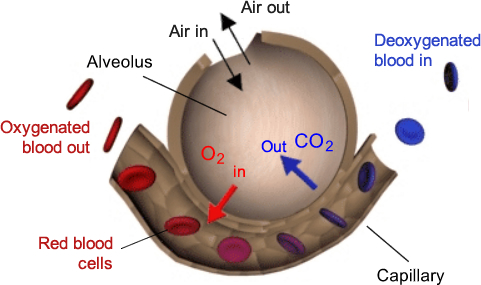
In the
alveolus (single air sac) oxygen passes from a high
concentration (loads of oxygen) through the thin wall into the blood
capillary where there is a low concentration (very
little oxygen) . This is called diffusion,
because oxygen is moving from high concentration to low
concentration. When blood returns to lungs it has high
concentration of carbon dioxide, so CO2 diffuses out of the
blood into the alveolus.
Note: Deoxygenated blood appears blue in this diagram for explanation purposes only.
Gas Atmospheric air Exhaled air Change Oxygen, O2 21% 16% -5% Carbon dioxide, CO2 0.04% 4% +4% Nitrogen, N2 78% 79% +1% Others 1% 1% 0%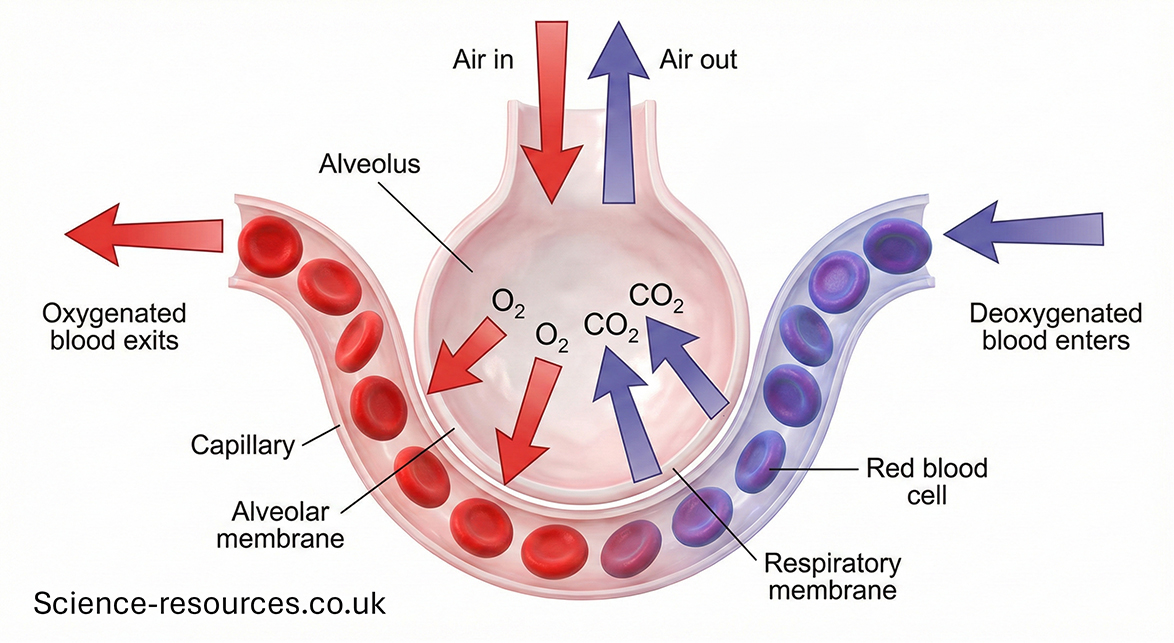
Breathing is a gas
exchange mechanism. Your Lungs help to
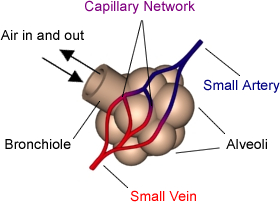
do just that! They contain millions of tiny
air pockets called ALVEOLI (air sacs)
which are adapted to maximise the diffusion of carbon dioxide and oxygen (see diagram
below). Alveoli are good at gas exchange because
they have:
Inhaled & exhaled air
When compared to atmospheric air, exhaled air contains:
How well do you know the mechanics of gas exchange? Test yourself below! 1. Diffusion is the movement of particles from... 2. Which gas diffuses FROM the blood INTO the alveoli to be breathed out? 3. How thick are the walls of the alveoli and the capillaries? 4. What does a "Steep Concentration Gradient" mean in the lungs? 5. Which adaptation increases the amount of gas that can diffuse at once?
🫁 Knowledge Check: Lung Diffusion
Check Your Answers
2. Carbon Dioxide (Waste product of respiration).
3. One cell thick (This provides a very short diffusion distance).
4. A large difference in gas levels (Maintained by breathing and blood flow).
5. A large total surface area (More space for molecules to pass through).
Tags:Diffusion, Lung diffusion, Exchange of gases, Alveoli, Lung cells