Dissolving
Dissolving During the dissolving process, solvent and solute particles collide. The solvent particles move around and slowly surround the solute particles until they are mixed well in the solvent.
To understand dissolving, we must first know what a solvent, a solute and a solution are.
For example, salt dissolves when it is stirred into water.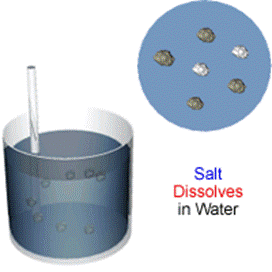
In the saltwater solution, salt is the solute and water is the solvent. The solute and solvent blend together in a solution. Conservation of Mass
There is a maximum amount of solute that can dissolve in a certain amount of solvent. When the solute cannot dissolve anymore, the mixture is called a saturated solution.
The solute does not vanish when it dissolves. For example, if 25 grams of water has 1 gram of salt dissolved in it, then the mass of the saltwater solution would be 25 grams + 1 gram = 26 grams.
Test your understanding of solutions, mixtures, and the dissolving process based on the lesson content. 1. In a mixture of salt and water, which substance is the 'solvent'? 2. If 10g of sugar is dissolved in 100g of water, what will the total mass of the solution be? 3. What term is used to describe a substance that CANNOT dissolve in a solvent? 4. A solution is described as 'saturated' when: 5. When a solute dissolves, what happens to its particles? Summary: 🧪 Knowledge Check: Dissolving
Click to Reveal Answers
2. 110g (Mass is conserved: 10g solute + 100g solvent).
3. Insoluble (Examples include sand in water).
4. No more solute can be dissolved (The limit of solubility has been reached at that temperature).
5. They spread out between solvent particles (They are still there, which is why the mass remains the same).