Unbalanced forces
Unbalanced forces Forces that are not equal in size or direction, are referred to as unbalanced forces.
A force is a push or a pull that can make an object move or change its motion. Sometimes, there are two or more forces acting on an object at the same time. If these forces are equal in size and opposite in direction, they are called balanced forces. Balanced forces do not change the motion of an object.
An object that is not moving will stay still, and an object that is moving will keep moving with the same speed and direction unless acted upon by an unbalanced force.
When we have unbalanced forces acting on an object:
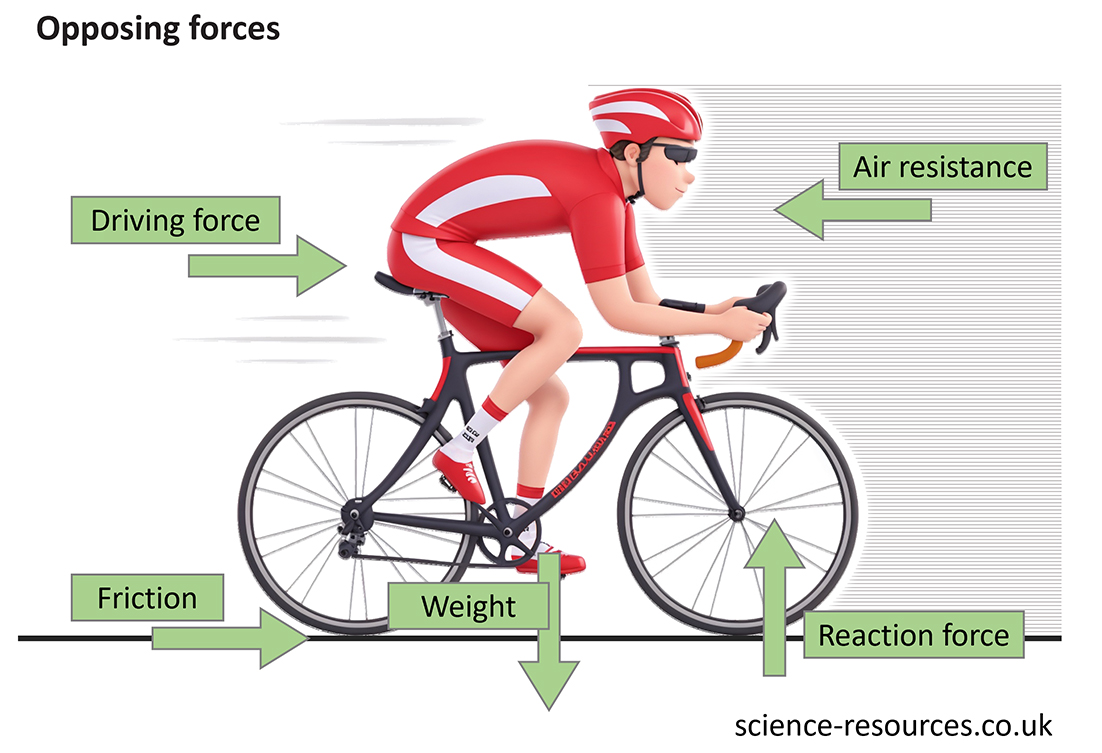
We can calculate the resultant force acting on an object by finding the difference between the two forces. Below is an example showing the opposing forces acting on cyclist.
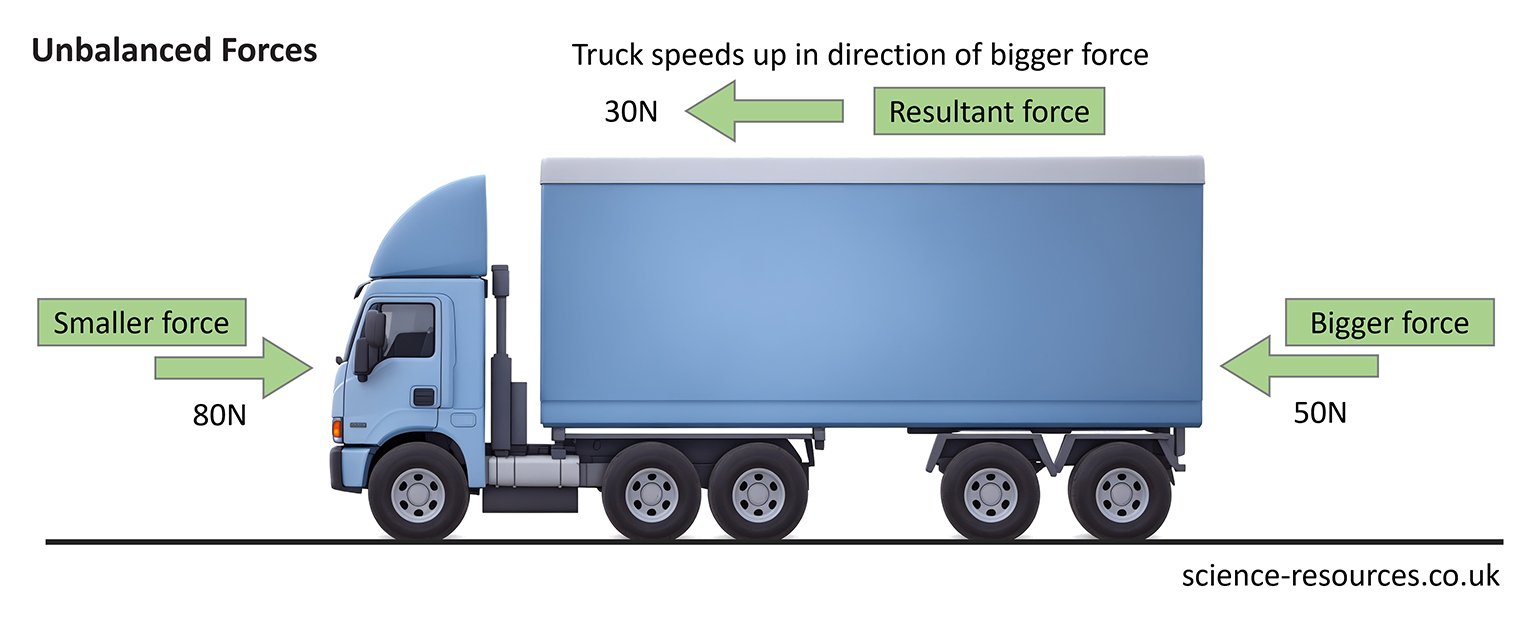
Using the example above, we can work out the resultant force on the truck:
The resultant force on this truck = 80N – 50N = 30N
If the driver of the truck accelerates, there will be a greater force (N) moving the truck forward, relative to the friction. This means that the truck will increase in speed. If the driver takes their foot off the accelerator, there will be a smaller force (N) moving the truck forward, compared to the friction. As a result, the truck’s speed will decrease.
When the forces are balanced, the force from the engine pushing the truck forward is equal to the friction and air resistance pushing the truck backwards. This won’t cause that truck to stop. Instead, the truck just keeps moving at a constant speed.
The change in the motion of an object depends on the following two factors:
Test your understanding of how resultant forces change the motion of stationary and moving objects. 1. If the forces acting on an object are NOT equal in size, what are they called? 2. What is the name of the single force that results from combining all forces acting on an object? 3. A stationary object is acted upon by an unbalanced force. What will the object do? 4. If a moving object is acted upon by a resultant force in the SAME direction as its motion, what happens? 5. Which of these is a possible effect of an unbalanced force on a moving object? Summary: 🔬 Knowledge Check: Unbalanced Forces
Click to Reveal Answers
2. Resultant force (The single overall force acting on the object).
3. Start to move in the direction of the resultant force (Unbalanced forces cause stationary objects to move).
4. It will speed up (accelerate) (Force in the same direction increases speed).
5. Changing its direction (Unbalanced forces can change speed OR direction).