Generative AI Notification: Some elements of this image have been created or enhanced using AI technology. To find out how we create all our prehistoric animals, click here.
Last updated: 4th August 2025
Extinct Animals: Dire Wolf
Dire wolf, an extinct prehistoric predator, most famous for its powerful build and bone-crushing jaws.
Dire Wolf (Aenocyon dirus)
 Dire wolf
What is a dire wolf?
The dire wolf was a large, prehistoric carnivore that lived during the last Ice Age. For over a century, people believed it was just a bigger cousin of the modern grey wolf. However, the latest scientific DNA evidence has completely rewritten its history! Scientists have discovered that the dire wolf was not a true wolf at all. It belonged to a completely separate, ancient line of canines that evolved in isolation in the Americas. Whilst it may have resembled a wolf, this was as a result of a process called convergent evolution.
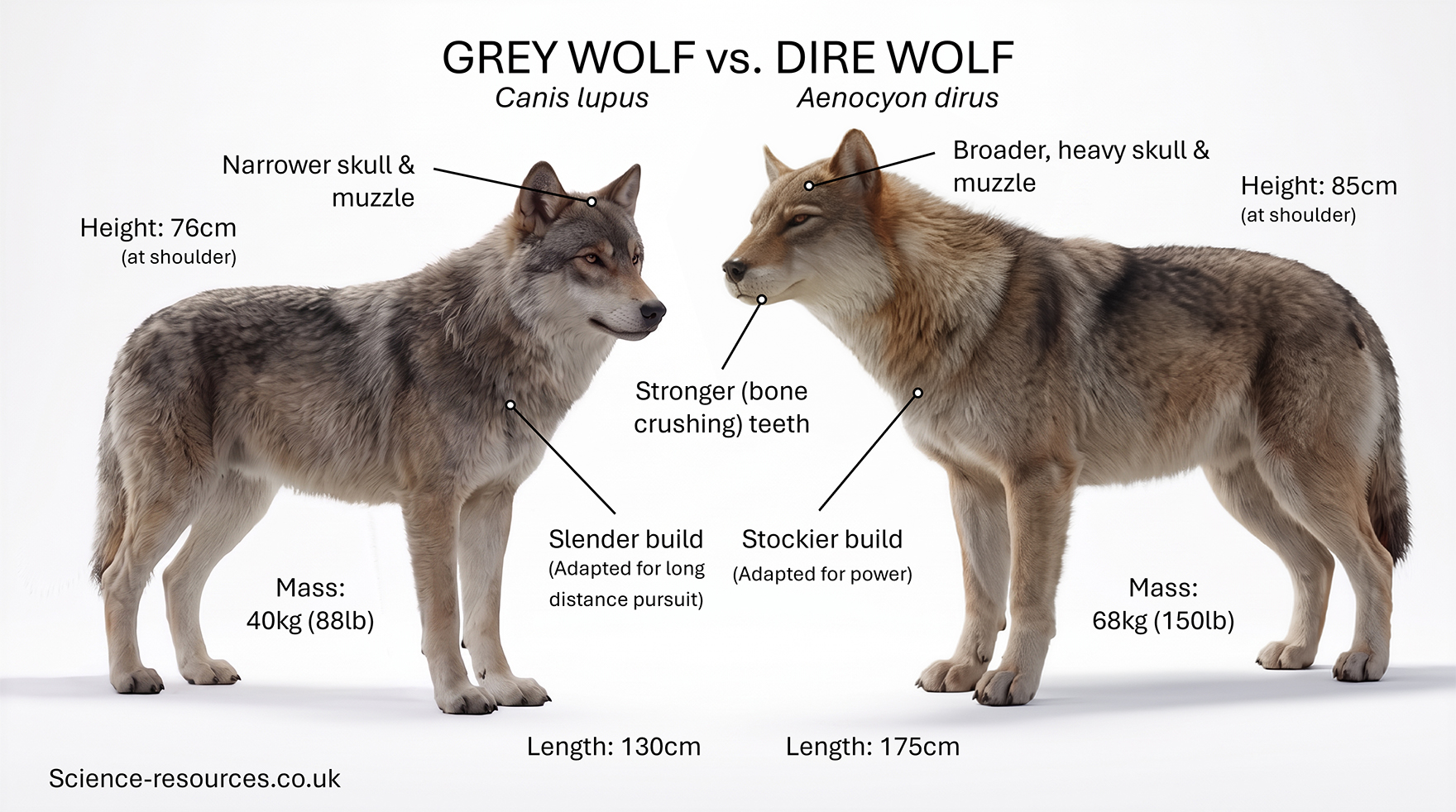 Modern-day grey wolf vs. dire wolf
How big was dire wolf?
Based on current evidence, scientists recognise two commonly named dire wolf species, Aenocyon dirus guildayi (Western dire wolf) and Aenocyon dirus dirus (Eastern dire wolf). Although large, dire wolves were not gigantic compared with the biggest modern grey wolves. They stood roughly 76-85 centimetres at the shoulder and measured about 1.5-1.7 metres in body length. The smaller western form, A. d. guildayi, is estimated to have weighed about 60 kilograms (132 lb) on average, while the larger eastern form, A. d. dirus, averaged around 68 kilograms (150 lb). Their most distinctive feature was not height but build: dire wolves had broader skulls, more powerful jaws, larger teeth and heavier bodies than modern grey wolves, adaptations for hunting large Ice Age prey.
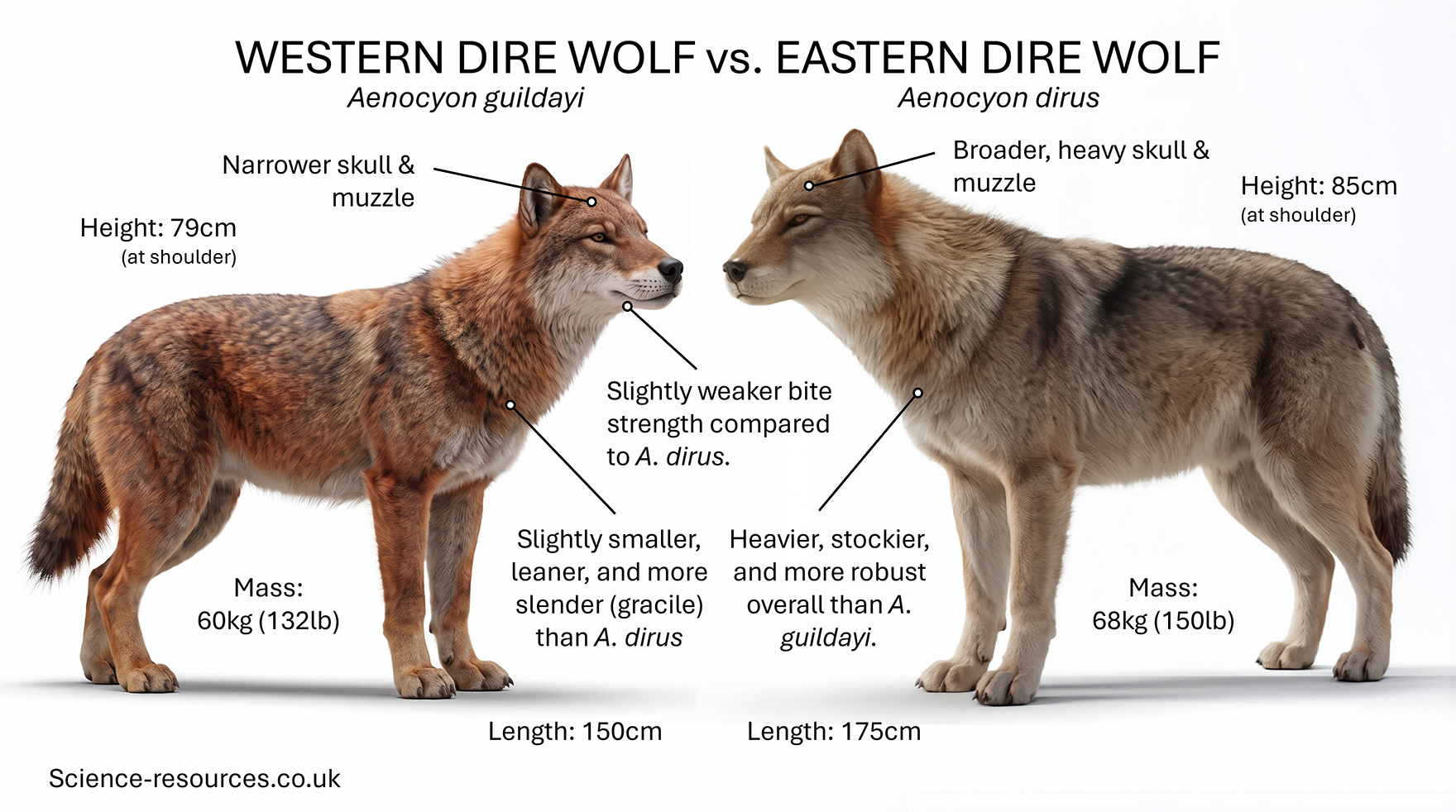
Dire wof size comparison (Left: Aenocyon dirus guildayi, right: Aenocyon dirus dirus.)
What did dire wolf eat?
Dire wolves were hypercarnivores, meaning their diet was almost 100% meat. They were specialised megafauna hunters, working in packs to tackle giant Ice Age mammals. Their favorite prey included ancient wild horses, western camels, and bison. Their jaws were incredibly wide and powerful, built to deliver a crushing bite.
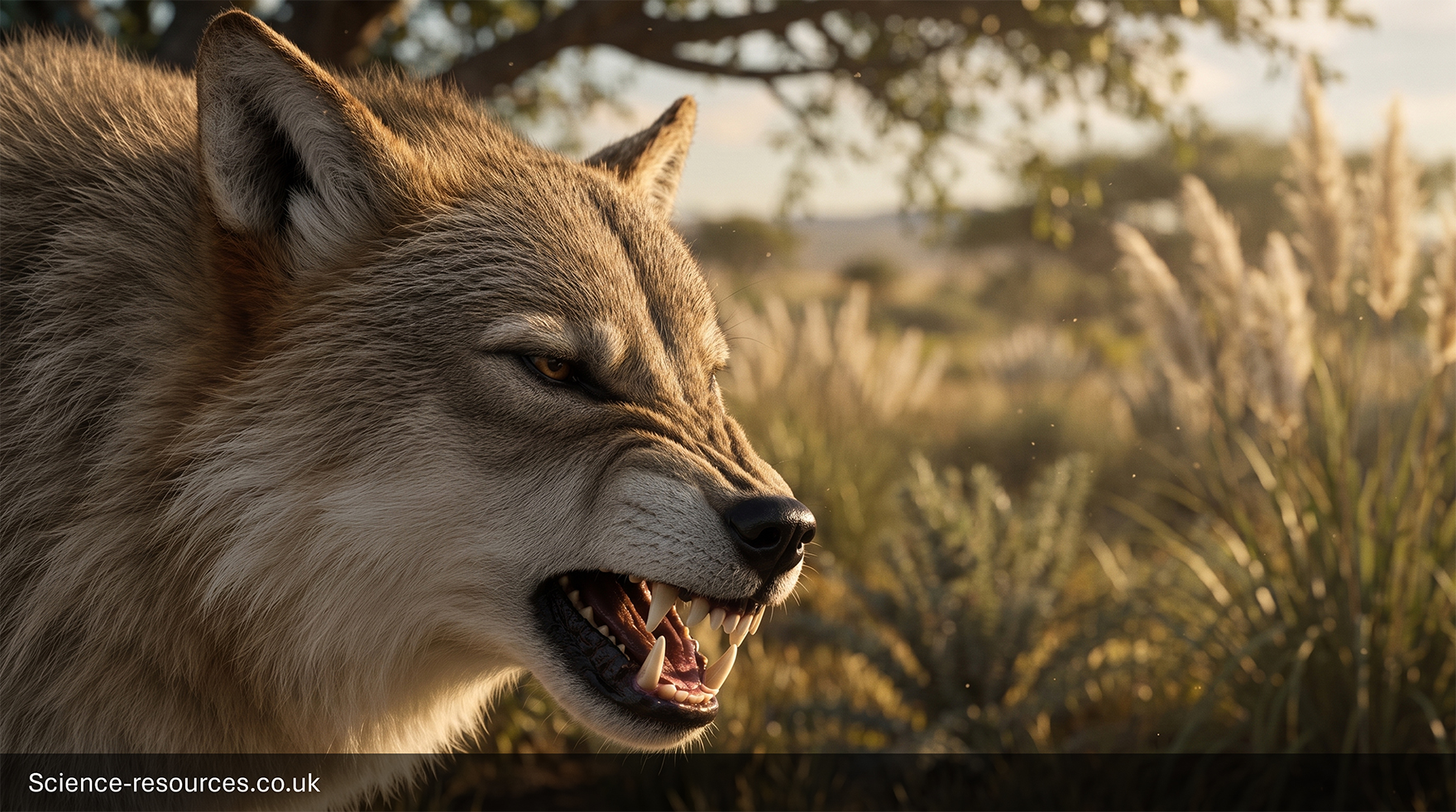
Dire wolf jaws were incredibly wide and powerful, built to deliver a bone-crushing bite.
Dire wolf appearance
Dire wolves looked similar to modern wolves but were stockier with a larger head and shorter legs. Key features:
- A thick, heavily-muscled body with a broad chest and a massive head.
- Exceptionally large, heavy teeth adapted for crushing bone and tearing tough hides.
- Shorter legs than modern grey wolves, meaning they were built for wrestling giant prey rather than running long distances.
- A unique genetic makeup that means their fur texture and coloration may have been quite different from modern northern wolves.
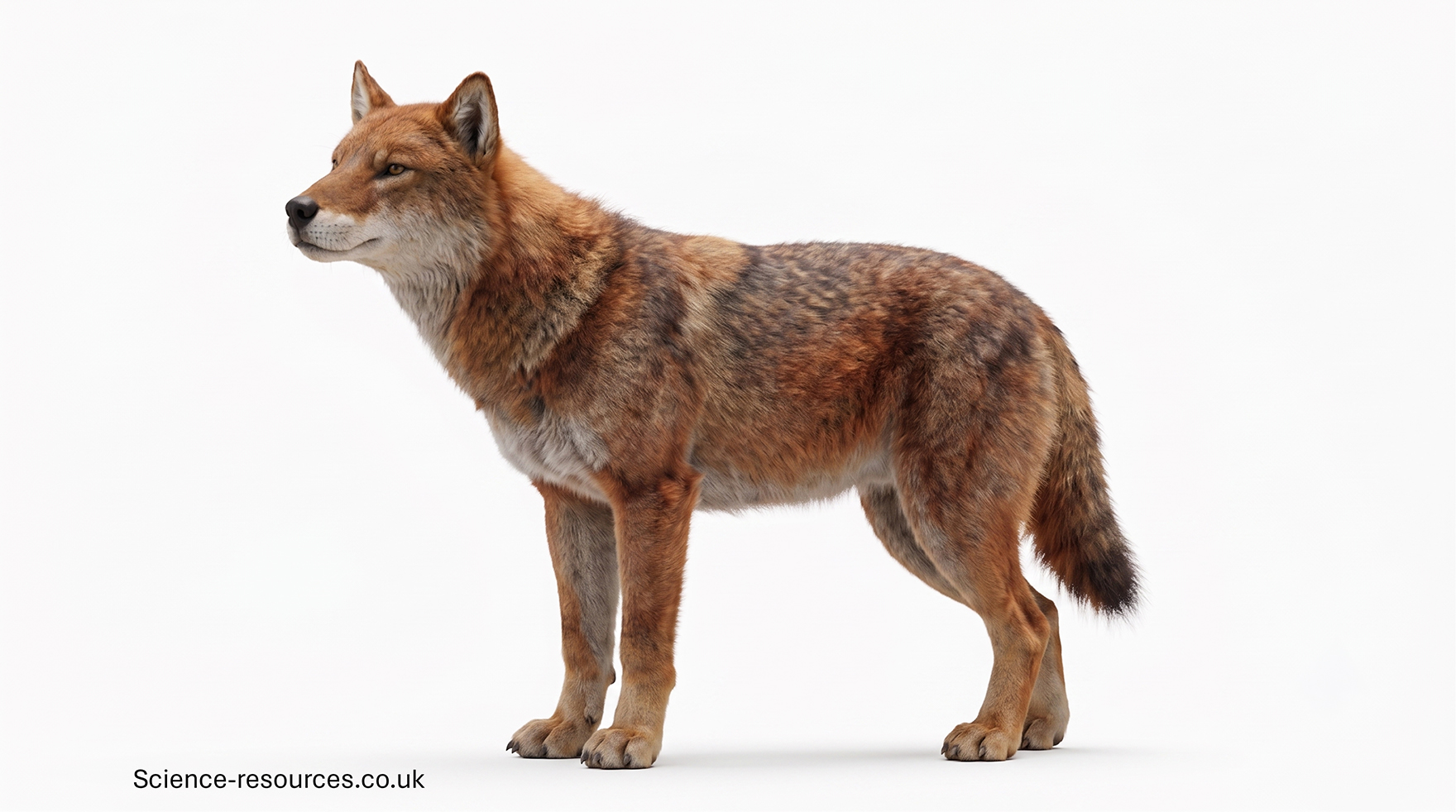 Dire wolf appearance
Where did dire wolves live?
Fossils have been found throughout North America, especially in places like the La Brea Tar Pits in California, USA. Some remains have also been discovered in South America.
Interesting facts
- In 2021, scientists successfully extracted ancient DNA from dire wolf fossils for the first time. They discovered that dire wolves split from the ancestors of grey wolves nearly 6 million years ago!
- Because of this huge genetic discovery, scientists officially moved the dire wolf out of the wolf genus (Canis) and gave it a brand-new scientific name: Aenocyon dirus, which means "fearsome terrible dog."
- Unlike modern grey wolves, domestic dogs, and coyotes which are closely related and can easily interbreed the dire wolf was so genetically distant that it could not mix or breed with any other living canine species.
- More than 4,000 individual dire wolves have been found preserved in the La Brea Tar Pits in California. They were likely tricked into entering the sticky tar when they tried to scavenge on other trapped animals.

Dire wolf Facts
Pronounced: DY-er wolf
Name Means: “Fearsome Wolf” (from Latin dirus, meaning “fearful” or “ominous”)
Length: Up to 1.5 metres (5 feet)
Height: Around 80 centimetres (2.6 feet) at shoulder
Weight: 60 - 70 kilograms (130 - 150 pounds)
Diet: Carnivore (Meat)
Time: Late Pleistocene Epoch (about 250,000 to 13,000 years ago)
Fossils Found: North and South America (especially USA, Mexico, Venezuela)
Which family of animals did dire wolves belong to?
They belonged to the family Canidae (the dog family). However, they were the very last surviving members of an ancient, unique line of canines. When Aenocyon dirus went extinct, its entire evolutionary branch completely died out.
Did dire wolves hunt in packs like modern-day wolves?
Scientists think that dire wolves probably did hunt in packs, much like modern wolves do today. Thousands of dire wolf fossils have been discovered together at sites such as the La Brea Tar Pits in California, suggesting that multiple individuals gathered around large prey animals. Their powerful bodies and strong jaws would also have made them well suited to working together to bring down large Ice Age animals such as bison, horses and camels.
However, because no one has ever directly observed a dire wolf, scientists cannot be completely certain about their behaviour. The evidence strongly suggests pack hunting, but details such as pack size and social structure remain unknown.
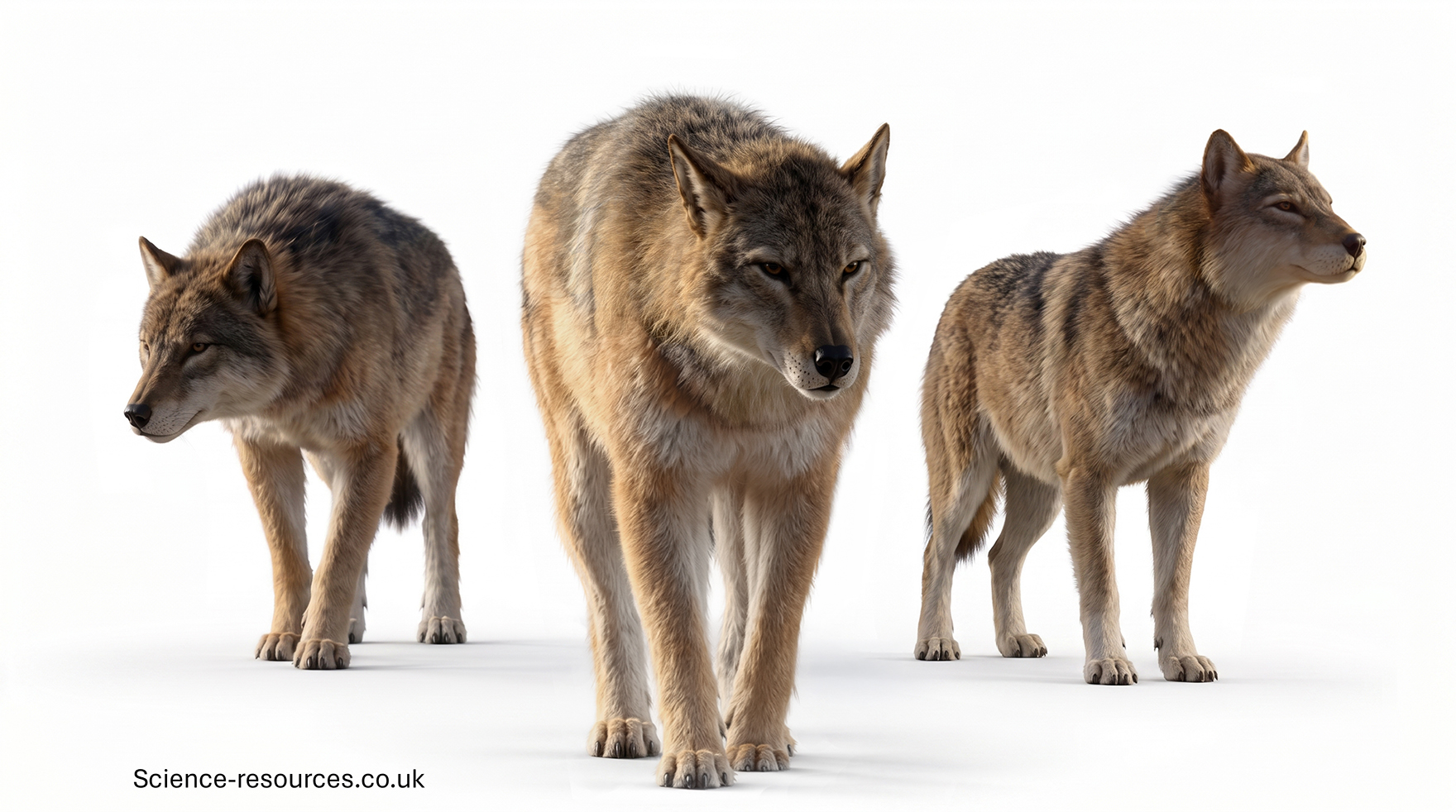
Pack of dire wolves (Aenocyon dirus dirus)
What other animals lived at the same time as dire wolves?
Dire wolves shared their world with giant ground sloths, sabre-tooth cats (like Smilodon), mammoths, American lions, and early humans during the last Ice Age.
Dire wolf FAQ
Q1: What was a Dire wolf?
A1. A dire wolf is an extinct prehistoric canine that lived in the Americas during the Ice Age. It was a powerful, heavy predator that hunted in large packs.
Q2. Are dire wolves closely related to grey wolves?
A2. No! The latest DNA evidence shows they are not close cousins at all. They belong to a completely separate branch of the dog family tree that split away millions of years ago.
Q3. What is the new scientific name for the dire wolf?
A3. Its new scientific name is Aenocyon dirus, which means "fearsome terrible dog." It was changed after DNA proved it didn't belong in the wolf group (Canis).
Q4. Could a dire wolf breed with a domestic dog or a grey wolf?
A4. No. Because they were an entirely isolated genetic lineage, they were too biologically different to ever interbreed or have puppies with modern wolves or dogs.
Q5. Was the dire wolf faster than a modern wolf?
A5. No, it was likely slower. Its shorter, sturdier legs and heavier skeleton mean it was built for ambush hunting and wrestling big animals, rather than chasing prey over long distances.
Q6. What color was a dire wolf's fur?
A6. While we can't know for certain, genetic traits suggest they evolved in warmer environments before the Ice Age, meaning they may have had darker, redder, or more brownish fur than modern grey wolves.
Q7. Why did so many dire wolves end up in tar pits?
A7. When a giant animal got stuck in the tar, it created an easy target. Entire packs of dire wolves would rush in to feed on it, only to get trapped in the sticky pools themselves.
Q8. Did humans ever see a live dire wolf?
A8. Yes! The first humans to arrive in the Americas lived alongside dire wolves for thousands of years and competed with them for the same prey.
Q9. Why did the dire wolf go extinct?
A9. When the Ice Age ended, giant animals like wild horses and bison disappeared. Because dire wolves were too heavy to hunt small, fast prey like deer, and couldn't interbreed with incoming grey wolves to survive, they eventually starved.
Q10. What did the latest DNA discovery teach us?
A10. It taught us that nature can create two animals that look almost identical on the outside (the grey wolf and the dire wolf) even though they are completely different animals!
You may also be intrested in:
- Extinct Animals: A-Z
- Dinosaurs: A-Z
Tags: How big was dire wolf, Dire wolf size, where did dire wolves live, how tall was wire wolf, what does dire wolf mean, Dire wolf facts
Previous: Daeodon
Up next: Doedicurus
© 2012 science-resources.co.uk. All rights reserved | Design by W3layouts
Extinct Animals: Dire Wolf
Dire wolf, an extinct prehistoric predator, most famous for its powerful build and bone-crushing jaws.
Dire Wolf (Aenocyon dirus)
Dire wolf
What is a dire wolf?
The dire wolf was a large, prehistoric carnivore that lived during the last Ice Age. For over a century, people believed it was just a bigger cousin of the modern grey wolf. However, the latest scientific DNA evidence has completely rewritten its history! Scientists have discovered that the dire wolf was not a true wolf at all. It belonged to a completely separate, ancient line of canines that evolved in isolation in the Americas. Whilst it may have resembled a wolf, this was as a result of a process called convergent evolution.
Modern-day grey wolf vs. dire wolf
How big was dire wolf?
Based on current evidence, scientists recognise two commonly named dire wolf species, Aenocyon dirus guildayi (Western dire wolf) and Aenocyon dirus dirus (Eastern dire wolf). Although large, dire wolves were not gigantic compared with the biggest modern grey wolves. They stood roughly 76-85 centimetres at the shoulder and measured about 1.5-1.7 metres in body length. The smaller western form, A. d. guildayi, is estimated to have weighed about 60 kilograms (132 lb) on average, while the larger eastern form, A. d. dirus, averaged around 68 kilograms (150 lb). Their most distinctive feature was not height but build: dire wolves had broader skulls, more powerful jaws, larger teeth and heavier bodies than modern grey wolves, adaptations for hunting large Ice Age prey.
Dire wof size comparison (Left: Aenocyon dirus guildayi, right: Aenocyon dirus dirus.)
What did dire wolf eat?
Dire wolves were hypercarnivores, meaning their diet was almost 100% meat. They were specialised megafauna hunters, working in packs to tackle giant Ice Age mammals. Their favorite prey included ancient wild horses, western camels, and bison. Their jaws were incredibly wide and powerful, built to deliver a crushing bite.
Dire wolf jaws were incredibly wide and powerful, built to deliver a bone-crushing bite.
Dire wolf appearance
Dire wolves looked similar to modern wolves but were stockier with a larger head and shorter legs. Key features:
- A thick, heavily-muscled body with a broad chest and a massive head.
- Exceptionally large, heavy teeth adapted for crushing bone and tearing tough hides.
- Shorter legs than modern grey wolves, meaning they were built for wrestling giant prey rather than running long distances.
- A unique genetic makeup that means their fur texture and coloration may have been quite different from modern northern wolves.
Dire wolf appearance
Where did dire wolves live?
Fossils have been found throughout North America, especially in places like the La Brea Tar Pits in California, USA. Some remains have also been discovered in South America.
Interesting facts
- In 2021, scientists successfully extracted ancient DNA from dire wolf fossils for the first time. They discovered that dire wolves split from the ancestors of grey wolves nearly 6 million years ago!
- Because of this huge genetic discovery, scientists officially moved the dire wolf out of the wolf genus (Canis) and gave it a brand-new scientific name: Aenocyon dirus, which means "fearsome terrible dog."
- Unlike modern grey wolves, domestic dogs, and coyotes which are closely related and can easily interbreed the dire wolf was so genetically distant that it could not mix or breed with any other living canine species.
- More than 4,000 individual dire wolves have been found preserved in the La Brea Tar Pits in California. They were likely tricked into entering the sticky tar when they tried to scavenge on other trapped animals.
Dire wolf Facts
Pronounced: DY-er wolf
Name Means: “Fearsome Wolf” (from Latin dirus, meaning “fearful” or “ominous”)
Length: Up to 1.5 metres (5 feet)
Height: Around 80 centimetres (2.6 feet) at shoulder
Weight: 60 - 70 kilograms (130 - 150 pounds)
Diet: Carnivore (Meat)
Time: Late Pleistocene Epoch (about 250,000 to 13,000 years ago)
Fossils Found: North and South America (especially USA, Mexico, Venezuela)
Which family of animals did dire wolves belong to?
They belonged to the family Canidae (the dog family). However, they were the very last surviving members of an ancient, unique line of canines. When Aenocyon dirus went extinct, its entire evolutionary branch completely died out.
Did dire wolves hunt in packs like modern-day wolves?
Scientists think that dire wolves probably did hunt in packs, much like modern wolves do today. Thousands of dire wolf fossils have been discovered together at sites such as the La Brea Tar Pits in California, suggesting that multiple individuals gathered around large prey animals. Their powerful bodies and strong jaws would also have made them well suited to working together to bring down large Ice Age animals such as bison, horses and camels.
However, because no one has ever directly observed a dire wolf, scientists cannot be completely certain about their behaviour. The evidence strongly suggests pack hunting, but details such as pack size and social structure remain unknown.
Pack of dire wolves (Aenocyon dirus dirus)
What other animals lived at the same time as dire wolves?
Dire wolves shared their world with giant ground sloths, sabre-tooth cats (like Smilodon), mammoths, American lions, and early humans during the last Ice Age.
Dire wolf FAQ
Q1: What was a Dire wolf?
A1. A dire wolf is an extinct prehistoric canine that lived in the Americas during the Ice Age. It was a powerful, heavy predator that hunted in large packs.
Q2. Are dire wolves closely related to grey wolves?
A2. No! The latest DNA evidence shows they are not close cousins at all. They belong to a completely separate branch of the dog family tree that split away millions of years ago.
Q3. What is the new scientific name for the dire wolf?
A3. Its new scientific name is Aenocyon dirus, which means "fearsome terrible dog." It was changed after DNA proved it didn't belong in the wolf group (Canis).
Q4. Could a dire wolf breed with a domestic dog or a grey wolf?
A4. No. Because they were an entirely isolated genetic lineage, they were too biologically different to ever interbreed or have puppies with modern wolves or dogs.
Q5. Was the dire wolf faster than a modern wolf?
A5. No, it was likely slower. Its shorter, sturdier legs and heavier skeleton mean it was built for ambush hunting and wrestling big animals, rather than chasing prey over long distances.
Q6. What color was a dire wolf's fur?
A6. While we can't know for certain, genetic traits suggest they evolved in warmer environments before the Ice Age, meaning they may have had darker, redder, or more brownish fur than modern grey wolves.
Q7. Why did so many dire wolves end up in tar pits?
A7. When a giant animal got stuck in the tar, it created an easy target. Entire packs of dire wolves would rush in to feed on it, only to get trapped in the sticky pools themselves.
Q8. Did humans ever see a live dire wolf?
A8. Yes! The first humans to arrive in the Americas lived alongside dire wolves for thousands of years and competed with them for the same prey.
Q9. Why did the dire wolf go extinct?
A9. When the Ice Age ended, giant animals like wild horses and bison disappeared. Because dire wolves were too heavy to hunt small, fast prey like deer, and couldn't interbreed with incoming grey wolves to survive, they eventually starved.
Q10. What did the latest DNA discovery teach us?
A10. It taught us that nature can create two animals that look almost identical on the outside (the grey wolf and the dire wolf) even though they are completely different animals!
Tags: How big was dire wolf, Dire wolf size, where did dire wolves live, how tall was wire wolf, what does dire wolf mean, Dire wolf facts
Previous: Daeodon
Up next: Doedicurus
© 2012 science-resources.co.uk. All rights reserved | Design by W3layouts