Transport system in plants
For
plants to maintain themselves, they need regular supply of various things.
Therefore, plants need a TRANSPORT SYSTEM. Xylem and Phloem are two separate sets of tubes for transporting materials around the plant. They
are independent of each other and are found in every part of the plant.
However, they are usually found close together. A group of xylem vessels
and phloem tubes is called a VASCULAR BUNDLE. Xylem
and Phloem vessels are used to carry different things around the plant. Xylem Vessels - Xylem
helps to support plants and take up water: Xylem
vessels are like a long drainpipe.
Xylem
Vessel They
are made from dead hollow cells, joined
end to end without any end walls between them, forming a
long open tubes. Phloem
Tubes - carry food materials which the plant has made and needs: Phloem
contain sieve-tube elements.
Phloem
Tube Sieve
tube elements have no nucleus, but contain cytoplasm. They
do not have any lignin in their cell walls. Made
from living cells, joined end to end, with punctured end-plates so that
materials can flow through. Each
sieve tube element has a companion cell next to it. Companion cell
has many organelles, except the nucleus. It is
thought that companion cells help the sieve tube elements with some of
their requirements. Phloem
tubes carry food made in the leaves to all other parts of the plant, in
either direction. The
growing part of the plant, in the root tips and shoot tips, receives
regular supply of sugars, fats, proteins etc. by the phloem tubes to/from
storage organs in the roots. In summary, Phloem carries food
to/from the roots for growth and storage from other parts of the plants. Xylem transports water and minerals
from the roots up to the leaves.
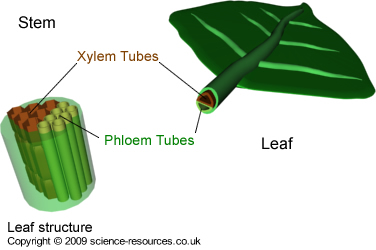
Xylem
vessels run from the roots of a plant, right up through the stem and
spread out into every leaf.
They
carry water and minerals from the root up to the leaves. This is known
as TRANSPIRATION STREAM.
Xylem
vessels contain no cytoplasm or nuclei.
Side
walls of Xylem vessels are strong and firm
containing lignin, which gives the plant support and keeps it upright.
Wood is made almost entirely of lignified xylem
vessels.

Test your knowledge on how plants move water, minerals, and food through their systems. 1. Which plant tissue is responsible for transporting water and minerals upwards from the roots? 2. What is the primary function of root hair cells? 3. By what process does water enter the root hair cells from the soil? 4. Which substance is transported by the phloem from the leaves to the rest of the plant? 5. What is the name of the process where water evaporates from the leaves, pulling water up the stem?🌿 Knowledge Check: Transport in Plants
Click to Reveal Answers
2. To provide a large surface area (Increases efficiency of absorption).
3. Osmosis (The specific method water uses to enter roots).
4. Glucose (sugar) (Produced in leaves and moved via phloem).
5. Transpiration (The "pull" that moves water through the plant).
Tags:Photosynthesis, Roots, Leaf structure, Stem, Xylem, Phloem, Cytoplasm, Nuclei, Transpiration