i


Osmosis - this is a special case of diffusion for water


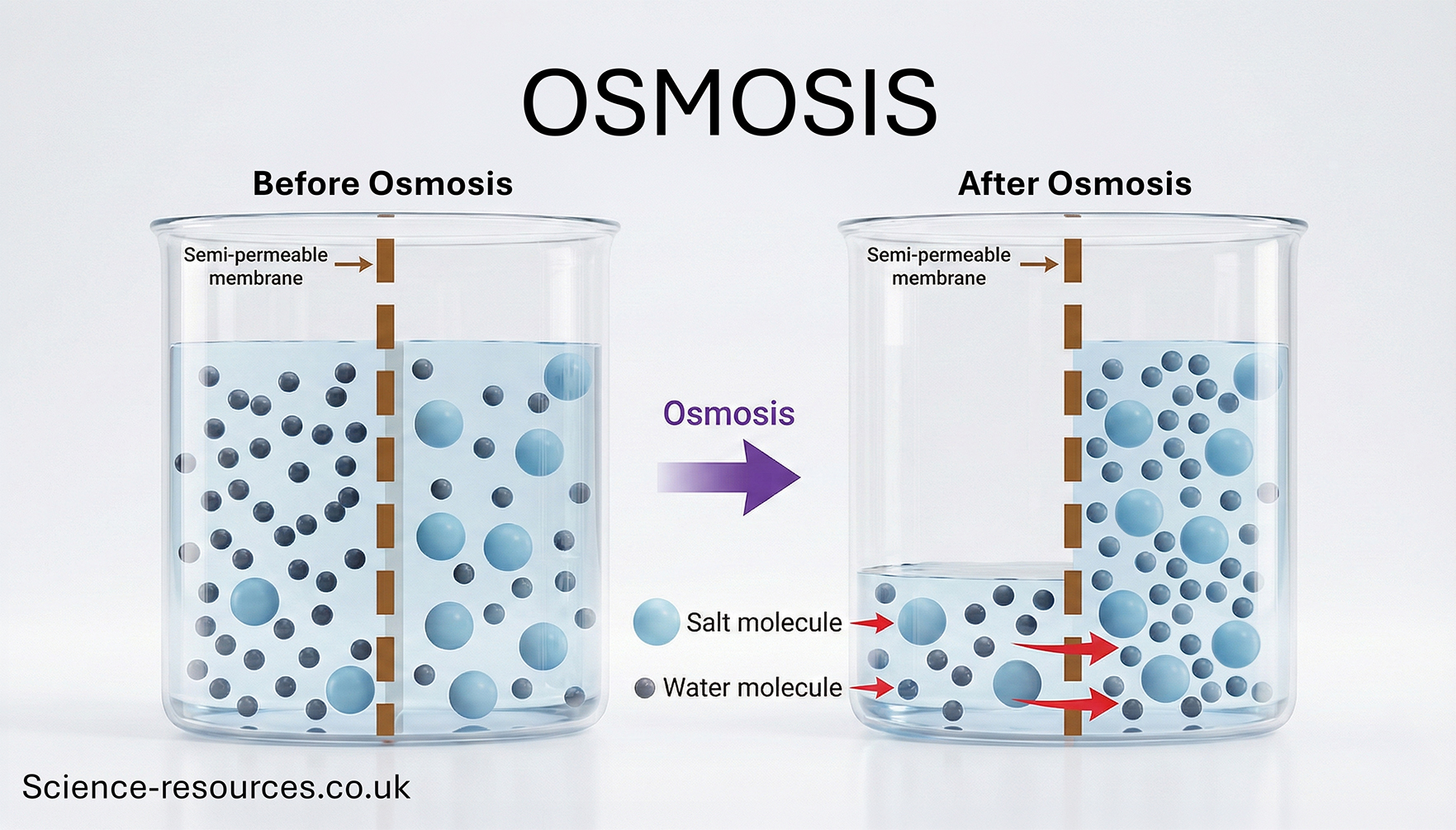
A diagram illustrates the process of osmosis in a beaker. The top of the image has the title "OSMOSIS." The diagram is divided into two main sections: "Before Osmosis" on the left and "After Osmosis" on the right, connected by a thick purple arrow pointing from left to right, labeled "Osmosis."

In the "Before Osmosis" section, a glass beaker is divided by a vertical, dashed brown line labeled "Semi-permeable membrane." Both sides of the beaker have the same level of liquid. The left chamber contains a high concentration of small, dark-grey spheres labeled "Water molecule" and a low concentration of large, light-blue spheres labeled "Salt molecule." The right chamber contains a lower concentration of water molecules and a higher concentration of salt molecules. A legend at the bottom left identifies the spheres.

In the "After Osmosis" section, the beaker and membrane are shown again. The liquid level in the left chamber has significantly decreased, while the liquid level in the right chamber has significantly increased. Red arrows indicate the net movement of water molecules from the left chamber (higher water concentration) across the semi-permeable membrane into the right chamber (lower water concentration). The salt molecules are shown remaining in their respective chambers, unable to cross the membrane. This demonstrates the net movement of water from a region of low solute concentration to a region of high solute concentration.


Osmosis is the movement of water particles across a semi-permeable membrane (partially permeable membrane PPM)  from an area of high water concentration to an area of low water concentration.  

Cell membranes are partially permeable because they will only permit some things to pass through, but not others.  The reason for this is that PPM has extremely small pores in it.  They are so small that only water particles can pass through them, and larger particle like glucose and proteins can not.  

  • The water particles in fact pass both ways through the visking tubing.
  • As there are more water particles on one side than the other, there is a steady net flow into the area with fewer water particles, i.e. more water particles moving into the glucose side, than other way round.
  • This results in water filling up the glucose rich side i.e. solution of glucose becomes diluted.  The movement of water particles carries on until both sides of the membrane has equal number.
  • Water enters the plant by osmosis through root hairs.  It make plant cells swell up and they become TURGID- (swollen).  TURGIDITY is important for plants as it is very helpful in opening STOMATAL  GUARD CELLS and giving support to green plant TISSUES.
  • Turgidity is not useful in the case of animal cells as they do not have a cell wall.  For this reason, animal cells can easily burst open if placed into pure water since they take in so much water by osmosis.

Experiment to demonstrate osmosis!

You can demonstrate this effect with VISKING TUBING, which is partially permeable membrane.  It is sometimes called dialysis tubing as it is used in kidney dialysis machines.  


From the animation it can be seen that water level in the glass tube begins to rise or fall because water either enters or leaves through the visking tubing by osmosis.


Remember: Potato Slices

It can be seen from the animation that potato slices, in pure water, swell up as water enters their cells by osmosis. 

However, in concentrated sugar solution the potato slices shrink as water leaves their cells as a result of osmosis.
Plant Structure and Function


💧 Knowledge Check: Osmosis

Test your understanding of how water moves in and out of cells.

1. Osmosis is the movement of which specific molecule?

2. In osmosis, water moves from a ______ solution to a ______ solution.

3. What describes a membrane that only lets small molecules pass through?

4. If a plant cell loses too much water and the cell membrane pulls away from the cell wall, the cell is:

5. Unlike active transport, osmosis is a 'passive' process. What does this mean?

Click to Reveal Answers
1. Water (Osmosis is exclusively water movement).
2. Dilute to Concentrated (Water moves to 'water down' the solute).
3. Partially permeable (Like a sieve for molecules).
4. Plasmolysed (This happens in very salty or sugary solutions).
5. Does not require energy (It follows the concentration gradient naturally).


Tags
:Osmosis, Movement of water particles, Semi-permeable membrane, Cells


© 2012 science-resources.co.uk. All rights reserved | Design by W3layouts