Conditions affecting the rate of Photosynthesis
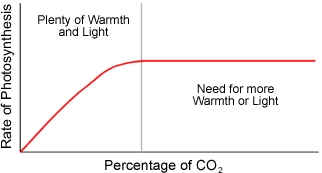
The amount of CARBON
DIOXIDE - the more carbon dioxide that is available to the plant, the faster the rate of photosynthesis, because carbon dioxide is one of the raw-materials. The amount of SUNLIGHT
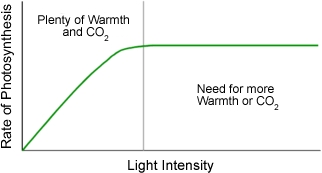
- the amount of light received by chlorophyll determines how quickly photosynthesis occur. The faster the
light strikes the leaf, the quicker the rate of
photosynthesis.
The type of light that hits the leaf is also important. Most plants appear green because they reflect green light. Therefore, green light does not take part in driving the process of photosynthesis. Red and Blue light are absorbed, hence these two
colours are the most important ones for photosynthesis. The TEMPERATURE
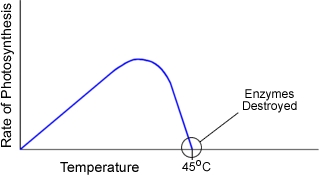
- photosynthesis is a chemical process,
controlled by enzymes such as chlorophyll. So it works best at
warm temperatures, but not too hot. From the graphs,
it can be said that if Light, carbon
dioxide and temperature are scarce, they will keep the rate of photosynthesis down. Therefore, they are called LIMITING FACTORS. For example,
on a hot, sunny day when there is plenty of light and high temperature,
the rate of photosynthesis depends on how much carbon dioxide there is. Carbon
dioxide is then said to be the limiting factor. The rate at
which photosynthesis occur depend on the following 3 factors:
Test your understanding of the factors that limit how quickly plants make food. 1. What happens to the rate of photosynthesis as light intensity increases? 2. If a plant has plenty of light and heat but very little carbon dioxide, what is the 'limiting factor'? 3. Why does the rate of photosynthesis drop if the temperature gets too high? 4. How can farmers use the science of limiting factors to grow crops faster in a greenhouse? 5. When a graph for light intensity levels off (becomes flat), what does this indicate?🔬 Knowledge Check: Photosynthesis Rates
Click to Reveal Answers
2. Carbon Dioxide concentration (This is the factor in short supply).
3. The enzymes are destroyed (Enzymes are protein catalysts that cannot survive extreme heat).
4. Increasing the concentration of carbon dioxide (This removes it as a limiting factor).
5. Light is no longer the limiting factor (The plant is working as fast as it can with the heat or CO2 available).
Tags:Photosynthesis, Rate of photosynthesis, carbon dioxide