i


Periodic Table Blaster


HI-SCORE: 0
STREAK: 0
LIVES: ❤️❤️❤️
SCORE: 0
LEVEL: 1

Target Element Name

HYDROGEN

Atomic #: ?

ELEMENT BLASTER

Identify the correct chemical symbol for the element displayed at the top!

Move Space Blast


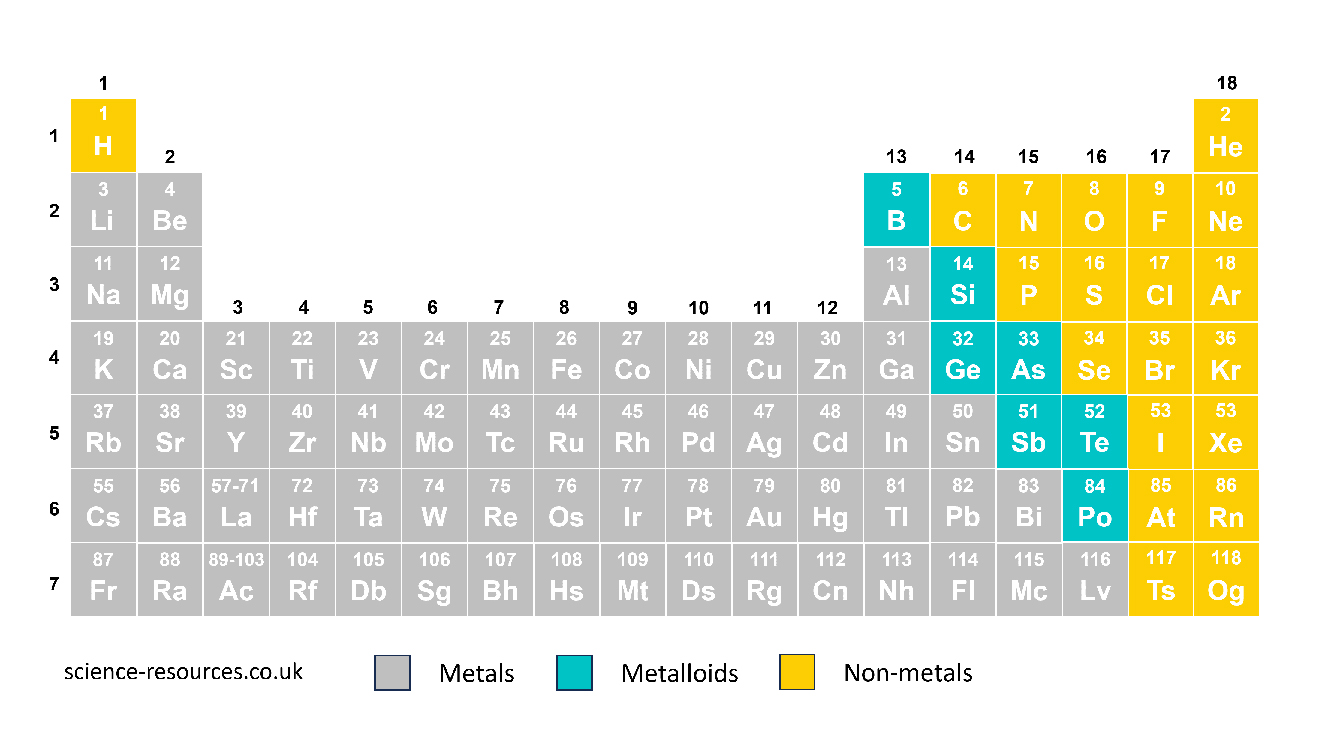
The periodic table


In the modern periodic table:


  • The atomic number of an element increases from left to right in the periodic table.
  • The periods are the horizontal rows in the periodic table.
  • The groups are the vertical columns in the periodic table.
  • Elements in the same group have similar properties.


A simplified periodic table is displayed against a white background. Each element is shown as a small square containing its atomic number at the top, its chemical symbol in the centre and its name underneath. The table uses colour coding to highlight three major categories: metals, metalloids and non‑metals.
Most of the table is filled with light grey squares, representing metals. These fill the left‑hand side, the central block, and the lower two rows, including familiar metals such as sodium, magnesium, iron, copper, silver, gold and the lanthanides and actinides.
A diagonal band of turquoise squares marks the metalloids. These include boron, silicon, germanium, arsenic, antimony, tellurium and polonium.
Several bright yellow squares identify the non‑metals, mainly located on the right‑hand side and the top left of the table. These include hydrogen at the very top, as well as carbon, nitrogen, oxygen, fluorine, phosphorus, sulphur, chlorine and the noble gases such as helium, neon, argon and xenon.
The atomic groups and periods are labelled with small black numbers along the top and left edges. A small legend at the bottom centre explains the colour coding:
• Grey for metals
• Turquoise for metalloids
• Yellow for non‑metals


Periodic table of elements


The table has one or two letters in each square, which are the element symbols. This makes the table less crowded and easier to find the elements.
The element symbol always begins with a big letter. If there is another letter, it will be a small letter, for example, He for helium. Some element symbols are easy. For example, O for oxygen. Others are not so easy. For example, Fe for iron, from the Latin word ferrum for iron.


More games


© 2012 science-resources.co.uk. All rights reserved | Design by W3layouts